

Rethinking Data Architecture
Hybrid models as a key to success
What Is Data Architecture - And Why Is It Crucial for Businesses?
A data architecture is the technological and organizational foundation that enables companies to collect, store, process, and make their data usable. Today, it supports all data-driven processes—from financial reporting to self-service analytics to artificial intelligence and real-time applications.
Data Architecture as the Foundation for Competitiveness and Innovation
Such a platform is indispensable today because data has become a strategic competitive factor. Companies that use data quickly and reliably make better decisions, respond more flexibly to market changes, and develop new business models. Outdated structures, on the other hand, hinder innovation and make it more difficult to meet regulatory requirements.
Given the need for SAP S/4HANA migrations, rising data volumes, and increasing pressure from AI, the question is no longer whether a modern data architecture is needed, but rather how it should be designed.
Why a Traditional Data Architecture Is Reaching Its Limits
Many companies started with a centralized data architecture—such as a traditional data warehouse or SAP BW as their “single point of truth.” This model has delivered reliable reports and financial and planning processes over a long period of time. However, it is no longer sufficient for modern analytics and AI requirements.
The challenges are obvious:
- New requirements in the areas of analytics, AI, or real-time processing are difficult and time-consuming to implement
- Scaling Issues with Growing Data Volumes and Increasing Data Diversity
- Departments remain heavily dependent on IT and are waiting for new requirements to be implemented
- New data-driven applications often take much longer than necessary to go live
- Significant effort required for adaptation and migration with every structural change
“This isn’t a tool problem. It’s a structural problem with the architecture.”
- From our experience working with companies undergoing transformation
The problem isn't the technology itself, but the assumption that a centralized approach can meet all requirements at once. This is exactly where the shift in thinking comes in.
Key Components of a Hybrid Data Architecture
A hybrid data architecture is not just a buzzword, but an approach that brings together four key components:
- Robust core systems for finance, planning, and regulatory reporting—on-premises or as a private cloud
- Scalable cloud components for analytics, AI, real-time processing, and self-service BI
- Centralized guidelines for security, data catalogs, and cross-platform access rules
- Clear responsibility within each subject area for its own data products
The key is to categorize data by use cases, not by chance or technology. Financial and compliance data require maximum stability and accuracy, whereas IoT or analytics data can be processed more exploratorily. A modern data architecture provides the appropriate framework for this.
What Matters in a Modern Data Architecture
Based on our consulting experience, we can identify five guiding principles that shape modern data architectures:
- Business Focus & Decision-Making Capability
Architectural decisions should be based on business-critical use cases. Without input from the business departments, a solution that addresses the truly relevant problems rarely emerges. - The right combination instead of a single solution
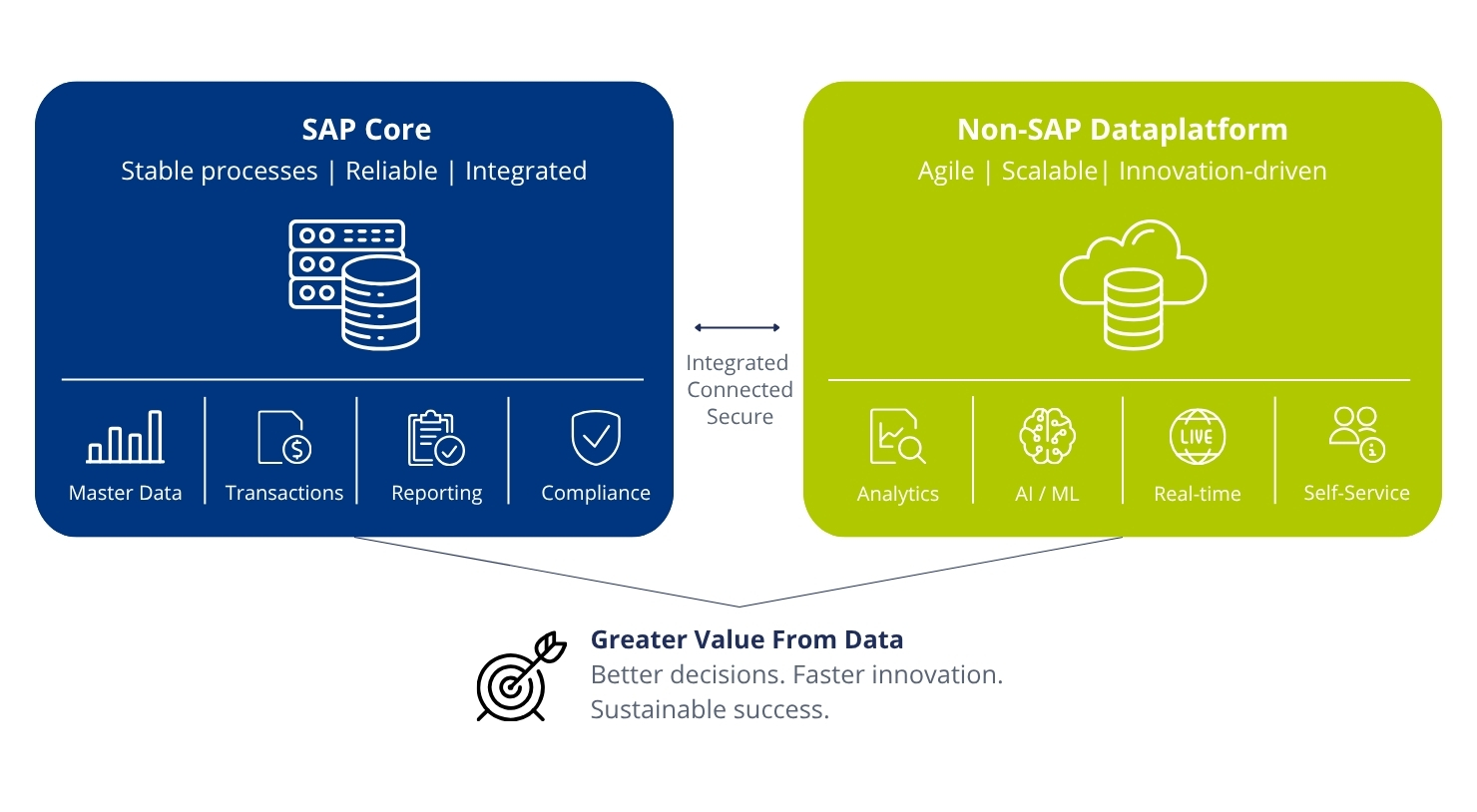
Instead of cramming everything into a single solution, specialized platforms should work together effectively. SAP systems remain the backbone of core processes, while cloud platforms such as Microsoft Azure, Azure Databricks, and Microsoft Fabric support requirements for analytics, AI, and real-time data. The key is collaboration, not replacement. - Focused on AI and growth from the very beginning
Data platforms should be designed from the outset to support AI and machine learning. This requires open data formats, scalable storage and computing resources, and clear interfaces for further processing. - Show the platform’s benefits early on
The impact should be visible early on. Hybrid architectures allow for a step-by-step approach: core processes remain stable while new layers of data and innovation are developed in parallel. - Incorporate governance from the very beginning
Governance should be considered from the very beginning, with data catalogs, clear access rules, traceable responsibilities, and transparency around data flows. This ensures broad access to data without losing control.
What a Data Architecture with a Hybrid Approach Looks Like in the Target State
The target model of a hybrid data architecture can be summarized in five characteristics:
- Reliable core systems for finance, planning, and regulatory reporting on an audit-ready basis
- Scalable cloud components for data lakehouses, AI, real-time processing, and self-service BI
- Key guidelines for data catalogs, security, quality, and access across all platforms
- Clear responsibility of the subject areas for their own data products
- A Sustainable Foundation for AI and Machine Learning
Typical examples of hybrid data architectures include, for example:
- Central Data Platform Plus Domain-Specific Data Products
- SAP-based core processes combined with cloud analytics and AI
- Traditional reporting supplemented by real-time and advanced analytics layers
A Concrete Example
SAP remains the system of record for finance and logistics, while AI and analytics use cases are implemented on an Azure data platform. This ensures that business-critical core processes remain stable and auditable, while new use cases can be developed, scaled, and integrated into the business units more quickly.
Where Does Your Organization Stand Today?
Before deciding on technologies, platforms, or target architectures, it’s worth taking an honest look at your current situation. These questions are designed to help with exactly that:
- Where does your organization stand today between stability and the pressure to innovate—and where do you want it to be in the next two years?
- Is there already a clear vision for the data architecture—or are decisions still being made primarily on a case-by-case basis?
- Which business-critical use cases truly drive architectural decisions today?
- Is the current data architecture already set up to support AI and data-driven use cases at scale?
- What role does the S/4HANA transformation play in the transition to a new data strategy?
- And what would be a realistic, sensible, and effective next step—without trying to tackle everything at once?
There are no universal answers to these questions. However, they make it clear that a hybrid data architecture is not merely a technology project, but a strategic and organizational undertaking.
Conclusion: Hybrid Data Architectures Are Not a Compromise—They Are the Answer
Hybrid data architectures are not a stopgap solution, but rather the strategic response to a reality in which both stability and innovation are required. The key is striking the right balance: reliable core systems, scalable innovation layers, integrated governance, and an active role for business units in data strategy.
Companies that consistently follow this approach not only build a robust data infrastructure but also improve their decision-making, responsiveness, and future-readiness.
Would you like to know where your organization stands on this journey? Then get in touch with us—from assessing your current situation to implementation.


Written by

Sabrina Barko Sherif is Consultant Data & AI at Arvato Systems. With a focus on data mesh, data strategy and data & AI governance, she supports companies in data-driven transformation processes and develops strategies to use data efficiently, responsibly and in a way that creates value.