


The Battery Passport as the First Concrete Application of the Digital Product Passport
What Companies Need to Know Now About Implementation and Why the Battery Passport Is Also Relevant to Their Digital Commerce Strategy
The Digital Product Passport is becoming a reality: Starting on February 18, 2027, the EU Battery Passport will become mandatory for certain battery categories, marking the first concrete application of the European Digital Product Passport (DPP). This raises three key questions for companies and provides important impetus for digital commerce.
1. What Requirements and Data Must Companies Take Into Account for the Battery Passport?
Before companies decide on platforms and technical solutions, they should gain a clear understanding of their current situation. This includes determining:
- affected products and external suppliers
- Product data required for internal and external use
- Data Sources and Existing Data Gaps
Starting February 18, 2027, the EU Digital Battery Passport will be mandatory for batteries in electric vehicles, industrial batteries with a capacity of more than 2 kWh, and batteries for light-duty vehicles.
This quickly turns the battery passport into a data issue. Relevant information may be scattered across ERP and SAP systems, PIM, PLM, manufacturing execution systems, battery management systems, document management systems, or supplier portals. Added to this are, for example, quality and service data. For a company’s sustainability and compliance managers, it is therefore not enough to simply be familiar with regulatory requirements. Together with product management and IT, they must ensure that the necessary information can be made available in a structured, machine-readable, and long-term accessible format.
The Battery Passport thus serves as a prime example of the importance product data will hold in the future. What companies structure and make available in a machine-readable format today for compliance purposes can also support product experience, digital services, and AI-powered commerce scenarios tomorrow. The first lesson for digital commerce is therefore: Product data is not just mandatory information, but a strategic resource.
2. How Can the Battery Passport Be Implemented in Practice and from a Technical Standpoint?
A key question for CIOs and IT and digital leaders is: How do I integrate the Battery Passport into existing IT and data landscapes without creating yet another siloed solution?
The starting point should be the existing architecture. Existing ERP, PIM, PLM, production, or document management systems do not necessarily need to be replaced. In many cases, they can continue to be used and integrated via standardized interfaces. The key point is:
- to link relevant data sources.
- To provide data in a consistent, machine-readable, and standardized format.
- To document changes in a way that is easy to follow.
- To make information available over the long term.
The introduction of the Battery Passport thus addresses a challenge that companies are already familiar with from digital commerce: fragmented data must be integrated and made usable across various systems, channels, and use cases. The second lesson, therefore, is: Future-proof digital commerce does not need yet another siloed solution, but rather an integrated and scalable data architecture.
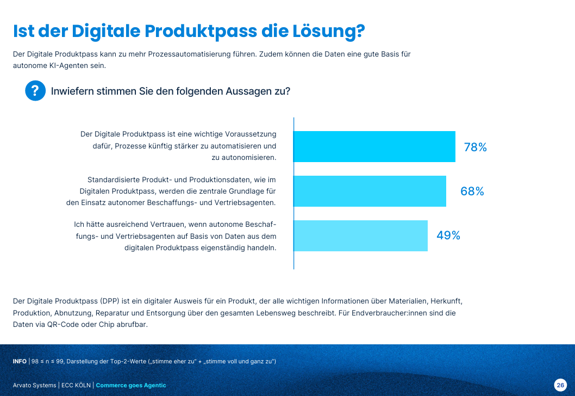
The current study "Commerce goes Agentic" by Arvato Systems and ECC KÖLN. It examines the Digital Product Passport not only from a regulatory perspective but also as a potential data source for automated and AI-supported processes.
One finding underscores this connection: 78 percent of the companies surveyed from retail and consumer goods industry view the Digital Product Passport as an important prerequisite for more automated and autonomous processes.
3. How Much Does It Cost to Implement a Battery Passport?
For product managers and CFOs at affected companies, in addition to technical feasibility, a particularly concrete question arises: How much will it cost to implement a battery passport for our products?
The amount of work required varies depending on each company's specific situation:
- Number of battery models and variants to be covered
- Annual Battery Production Volume
- Availability and Digital Collection of the Required Data
- Usability of Existing Systems and Processes
- Status of Preliminary Work to Date on the Implementation of the Battery Passport
The third lesson for digital commerce is: The value of a future-proof database can only be assessed in the context of existing products, systems, and processes. A reliable estimate of the effort required must therefore always be based on the individual starting point.
Arvato Systems offers companies affected by the EU Battery Regulation a no-obligation initial assessment of the potential implementation effort based on six simple questions. Get started now.
From the Battery Passport to a Digital Commerce Strategy
The Battery Passport brings the Digital Product Passport to life for the first time and highlights three key insights: Companies need reliable, machine-readable product data; an integrated data and system architecture; and a realistic assessment of their individual starting point.
First and foremost, these measures lay the groundwork for the implementation of the EU Battery Regulation. However, their strategic value extends beyond that. Product data that is structured and available across systems can also support digital services, product experience, omnichannel commerce, and AI-powered scenarios in the future.
The Battery Passport is thus not only the first concrete use case for DPP; it can also serve as the starting point for a product data strategy that combines compliance and digital commerce.
At Arvato Systems, our philosophy is: Compliance is the starting point. Connected product data is the foundation. Digital commerce opens up new possibilities.


Written by

Kimberly is a product strategist who focuses on digital applications in agriculture, healthcare, and retail. With experience in project management, she supports the development of practical solutions, from process digitization to the implementation of regulatory requirements.