

SDDC – Private Cloud at the Push of a Button
The foundation for fast, secure, and predictable IT projects
Shorter Deployment Times, Stable Platforms, Integrated Compliance
Modern companies need IT infrastructures that grow with their business, meet the highest security requirements, and can be quickly adapted—without complexity or inefficiencies.
We offer a proven, automated software-defined data center solution that combines speed, security, and operational excellence from the very start.
At the heart of it all is a clear concept: The private cloud as a predictable, standardized, digital city—rather than individual, one-off projects.
A Software-Defined Data Center (SDDC) is a fully virtualized data center in which all core IT resources—such as computing power, storage, and networking—are controlled via software and provisioned automatically. Unlike traditional infrastructures, where hardware is configured manually, an SDDC enables dynamic, flexible, and on-demand use of resources. Through the use of virtualization and intelligent software, workloads can be efficiently distributed, processes automated, and new services deployed more quickly. As a result, companies benefit from greater scalability, increased agility, and improved utilization of their IT resources. A Software-Defined Data Center (SDDC) forms the foundation for modern IT strategies.










The SDDC Concept – The Digital City
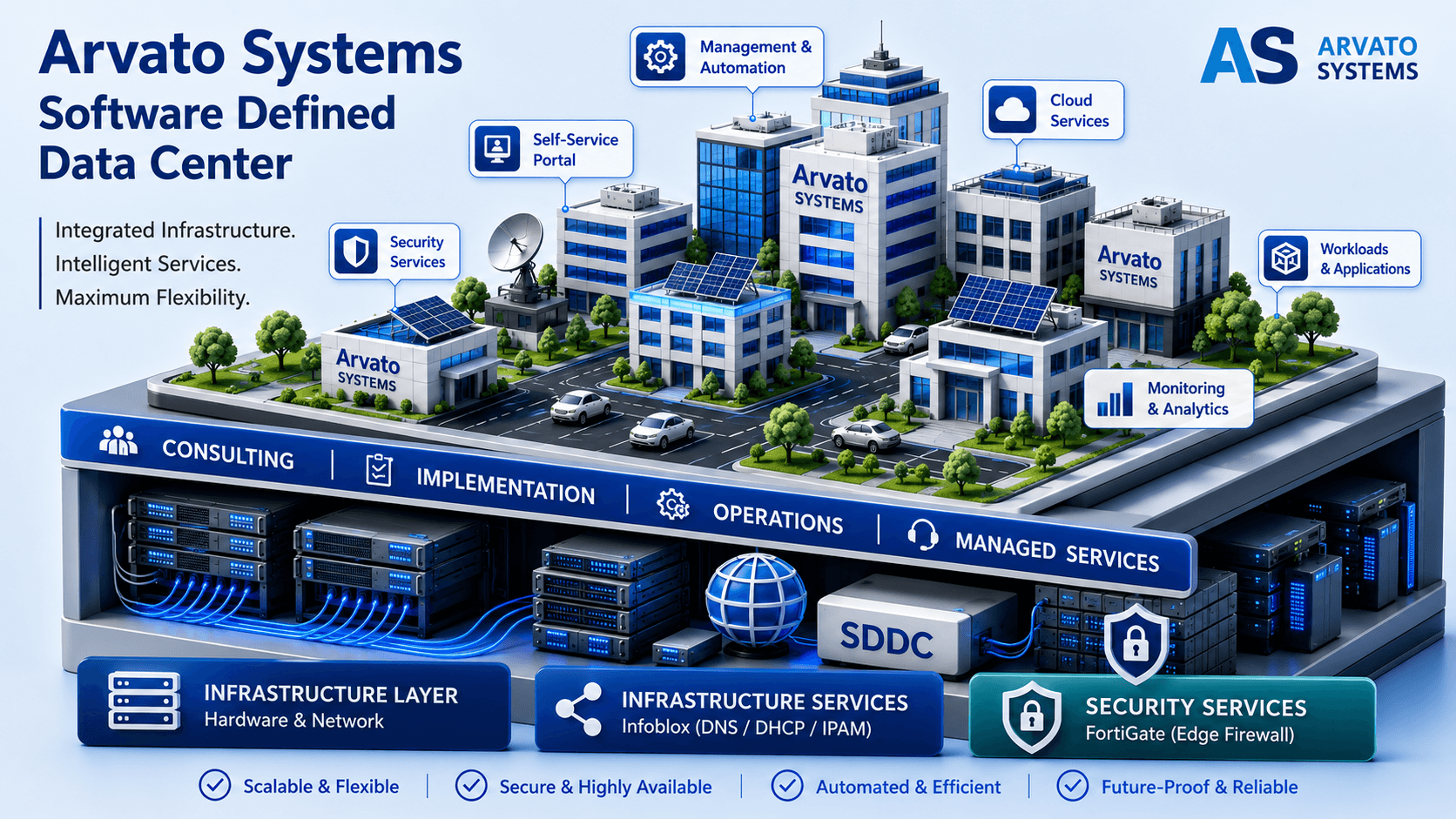
The SDDC platform is visualized as a digital city:
- Districts (zones): clearly defined security and functional areas
- Buildings (Service Patterns): standardized infrastructure and application patterns
- Infrastructure: Automation, Monitoring, ITSM, Security, and Governance
We take on the role of urban planner and operator for you—with clearly defined rules, standards, and development paths. All components are certified,versioned, documented, andcompatible.
Your benefits: A controlled, repeatable environment instead of ad-hoc IT landscapes.
SDDC 1.0 – All Integrated Services at a Glance
-
Foundation
- Data Center Architecture: Dual data centers with HA cluster services, geo-redundancy
- Underlay Network: Spine-Leaf Fabric (ACI), ECMP Load Balancing, Deterministic Routing
- OOB & Management: Out-of-Band Network, Dedicated Management Zones, Remote Recovery Access
-
Network Services
- Basic Services: DNS / DHCP / IPAM (DDI), NTP Time Services
- Connectivity: LAN/WAN (802.1X, NAC), WAN / SD-WAN, VPN (S2S, Remote)
- External Access: Cloud Connect (Azure/AWS), Internet Perimeter, Proxy & TLS Inspection
-
Compute
- Virtualization: VMware VCF, vSphere (ESXi), NSX Integration
- Server Management: Bare-Metal Provisioning, VM Lifecycle Management, Patch Automation
- Container Platform: Kubernetes, autoscaling, CI/CD integration
-
Storage & Data
- Storage Types: Block (vSAN), File (NFS), Object (S3)
- Data Protection: Backup (Veeam), Immutable Storage, Disaster Recovery
- Databases: Oracle / MSSQL / PostgreSQL, HA clustering, replication
-
Network Security
- Perimeter Security: Next-Gen Firewall, Intrusion Prevention, TLS Inspection
- Microsegmentation: NSX Distributed Firewall, zone-based policies, east-west control
- Detection & Response: IDS/IPS, NDR (Anomaly Detection), Threat Intelligence
-
Identity & Access
- Identity Management: Active Directory / Entra ID, SSO (Keycloak), PAM/PIM
- Access Control: Zscaler ZPA/ZIA, Conditional Access, MFA
-
Platform Services
- Core Services: IAM / Identity, PKI / Certificates, File Services
- Advanced Services: AI Platform, Middleware, API Gateway
-
Automation & DevOps
- Automation: Infrastructure as Code, Terraform / Ansible, GitOps
- CI/CD: GitHub Actions, Pipeline Automation, Artifact Repositories
-
Operations
- Monitoring: Observability, Logging, Event Management
- ITSM: Incident / Change Management, CMDB, Service Portal
- Operations Center: ITDC 24/7, SOC Integration, Capacity Management
End-to-End Delivery Flow – From Inquiry to Ongoing Service
A standardized process for deployment and changes:
Who Is the SDDC Platform Ideal For?
- Companies with high standards for security & compliance
- Organizations that need to deploy new platforms quickly
- Customers with multiple projects or environments who are looking to standardize
- IT organizations that want to strategically embed operational excellence and automation
Why Arvato Systems?
With Arvato Systems, you’re partnering with a provider that takes a holistic approach to SDDC: from high-performance on-premises platforms to certified security with a 24×7 SOC, all the way to integrated ITSM/CMDB operations. Our experience and industry expertise ensure that your transformation is a success—with maximum stability and auditability for critical business processes.

Standardized. Secure. Scalable. Our Software-Defined Data Center is the foundation of your modern IT.
Frequently Asked Questions About SDDC
-
What is an SDDC?
A Software-Defined Data Center (SDDC) is a fully virtualized data center in which infrastructure components such as compute, storage, and networking are controlled via software. This allows IT resources to be flexibly provisioned, automated, and centrally managed—regardless of the underlying hardware. The result: greater agility, higher efficiency, and faster adaptation to new requirements.
-
Why an SDDC?
A Software-Defined Data Center (SDDC) enables the flexible, automated, and efficient provisioning of IT resources. Software-based control of compute, storage, and networking accelerates processes, reduces manual effort, and optimizes costs. Companies benefit from greater agility, better scalability, and a faster response to new business requirements.
-
What are the core components of an SDDC?
The core components of a software-defined data center are compute, storage, networking, and security, all of which are controlled entirely through software. These are complemented by automation and management to centrally orchestrate and efficiently operate all resources.
This results in a flexible, scalable, and highly automated IT infrastructure. -
Why is Arvato Systems the right partner for an SDDC?
With Arvato Systems, you can rely on an experienced partner that provides all SDDC components from a single source—from infrastructure and security to operations.
Our expertise—backed by certifications, partnerships, and client references—ensures the secure implementation and reliable operation of your IT infrastructure.
Your Contact for SDDC
