Öffentlicher Sektor Branchenseite - Stagebild

Modern IT solutions for public administration

Together we are taking the next step into the digital future

Dr. Norbert Ahrend Profilfoto
YOUR CONTACT

Digital Transformation for the Public Sector - Secure, Confident and Holistic

At Arvato Systems, we provide federal, state, and local authorities with holistic support on their path to the digital future - from strategic consulting and technically sound implementation to secure and scalable operation. In doing so, we combine a deep professional understanding of public administration requirements with technological excellence.

Workplace of the future

Public administration is faced with the task of enabling collaborative and mobile working for its employees across the board while meeting high information security and data protection requirements. At the same time, there is a growing desire for sovereign alternatives to established providers, particularly through open source applications. The workplace of the future bundles applications, information and collaboration on a central platform and supports location-independent working.

Agentic AI

Agentic AI, also known as agentic AI, extends classic AI applications with digital employees who not only answer tasks, but can also carry them out independently within defined guard rails. This creates a new lever for public administration to reduce the burden on specialist processes, shorten processing times and increase service quality. At the same time, there are high requirements for data protection, traceability, role and authorization concepts as well as sovereign operation in a legally secure area.

Automation & dark processing

Public administration is under considerable pressure to increase productivity due to demographic change and the increasing shortage of skilled workers. At the same time, case numbers and complexity are increasing. Automation makes it possible to consistently process standardized, rule-based processes digitally. The prerequisites for this are clear decision-making logic, consistent verifiability of decisions and controlled exception and escalation management.

Bundling of service processes
Digital governance

Germany's administration needs lean processes that are well supported by standardized software. In the federal system, a lack of standards, different priorities and fragmented IT ecosystems lead to parallel developments and dependencies that are difficult to control. Effective, cross-departmental and cross-level digital governance creates order here by increasing commitment and establishing guidelines for architecture, data and security.

Data Driven Government

Public administration has extensive data at its disposal, but often only makes limited use of its potential. Different data formats, diverse specialist procedures, unresolved data protection issues and a lack of standards make it difficult to use it effectively. Data-driven governance means systematically collecting data, sharing it within the administration and evaluating it securely.

Modernization of specialist processes

The modernization of specialist procedures is a key lever for providing administrative services digitally, efficiently and securely. Many systems are technologically outdated, difficult to maintain and only have limited connectivity to portals, registers and overarching workflows. User interfaces and process support are often not aligned with today's expectations. Data models, interfaces and security mechanisms have grown heterogeneously and are susceptible to faults and errors. Modernizing specialist processes therefore means renewing the front end and back end together and establishing modularity and interoperability.

Multi-cloud

The public sector relies on the use of cloud environments for the networked, scalable operation of IT applications. This is countered by high demands on sovereignty and security. With the German Administrative Cloud Strategy, the federal and state governments are addressing precisely this area of conflict and calling for more independence and the ability to switch to the cloud.

Cyber Security

Cyber attacks are one of the biggest risks to the operation of government services today. Ransomware, data theft and attacks on critical infrastructures hit public sector organizations particularly hard because availability, data protection and verification must be guaranteed at all times. Individual tools are not enough. What is needed is a holistic approach comprising prevention, detection and response, which includes IT and, depending on the context, also OT.

SAP Services

SAP is often the backbone for cross-sectional processes such as budgeting, procurement, human resources and reporting in public administration. At the same time, the pressure to modernize is growing due to increasing security and compliance requirements, heterogeneous system landscapes and the need for standardization and automation.

Cloud & Data Center Transformation

Public administration is faced with the task of fundamentally transforming its cloud and data center landscapes in order to be able to operate specialist processes in a future-proof, secure and economical manner. High requirements in terms of information security, data protection and record keeping come up against heterogeneous legacy landscapes, manual operating processes and limited scalability. At the same time, new digital services must be provided more quickly and existing systems must be modernized step by step without jeopardizing ongoing operations.

Overall national resilience

Governmental resilience describes the ability of the federal and state governments to reliably perform their core tasks even in crises and exceptional situations. Natural disasters, cyber attacks, supply bottlenecks or disruptions to critical infrastructures require rapid situational awareness, coordinated decisions and clear responsibilities across federal levels and departments.

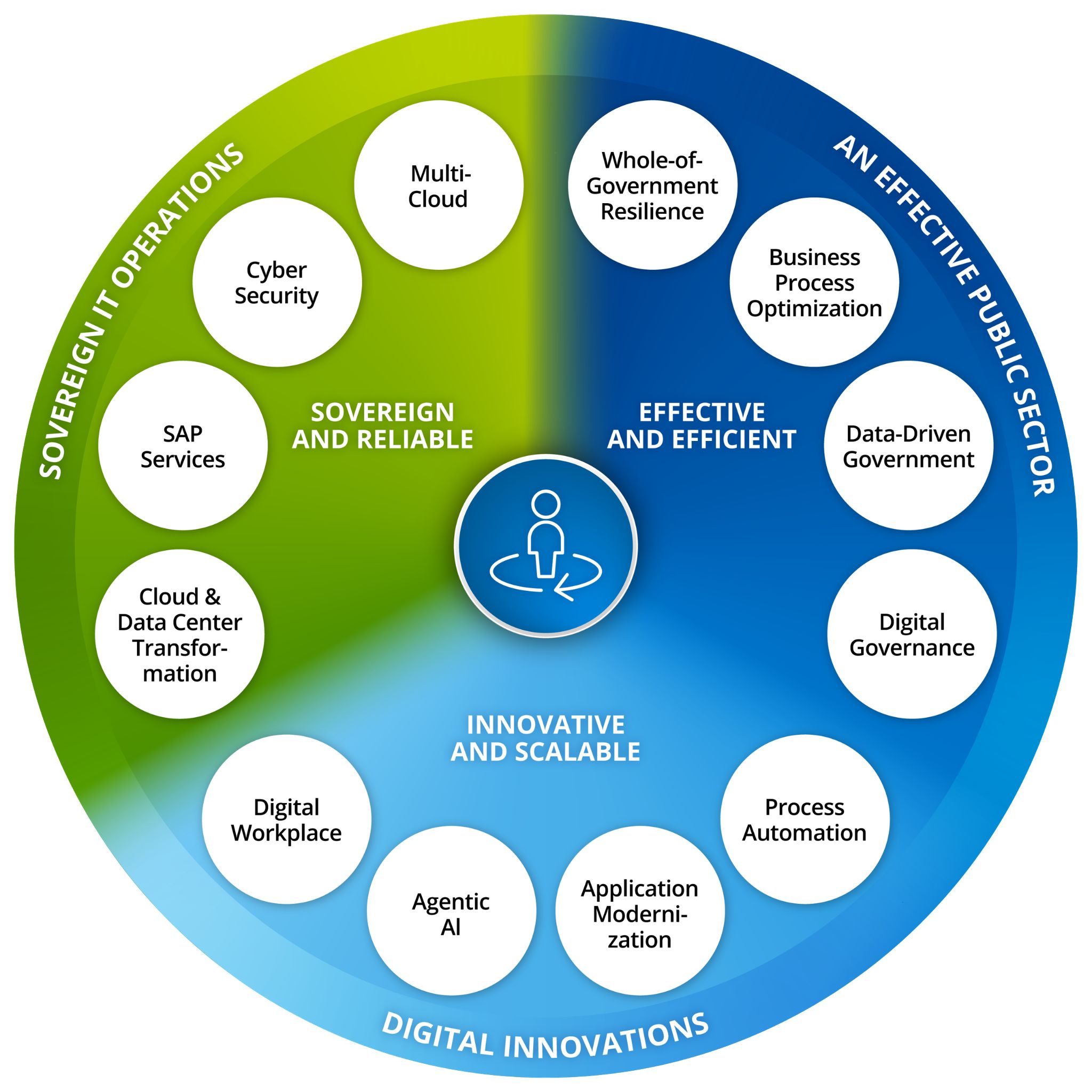
Arvato-Systems-Public_Wheel_1123m

As an end-to-end partner, we cover the entire digital value chain - integrated, confident and from a single source. Our aim is to combine innovation and operational stability and to support the public sector on its way to greater efficiency and better services for citizens and companies. The highest security standards and digital sovereignty are always at the heart of everything we do.

Overall national resilience
Bundling of service processes
Data Driven Government
Digital governance
Automation & dark processing
Modernization of specialist processes
Agentic AI
Workplace of the future
Cloud & Data Center Transformation
SAP Services
Cyber Security
Multi-cloud
Dr. Norbert Ahrend profile photo

With its data centers in Germany and its multi-cloud expertise, Arvato Systems is the ideal partner for digital sovereignty. The skills of our approximately 3,500 employees form the basis for successfully shaping public administration's path to a digitally sovereign future.

Arvato Systems
Arvato Systems & Delos Cloud

Delos Cloud

Arvato Systems & Delos Cloud: Sovereign cloud solutions for the German administration - secure, data protection-compliant and Microsoft-based.

Drive more

Extract from our references

SAP migration and operation for Bayerische Staatsforsten
Telematics infrastructure for gematik
Business partner conversion in an existing ERP system
Digitization of Leipzig's municipal utilities
Highcompressed_638598730

Sovereign IT - More independent. More secure. More resilient.

Avato Systems has been focusing on top technologies and dealing with critical infrastructures for years. We are your partner for sovereign IT.

Learn more

Insights

Sovereign IT Forum

At our 9th Sovereign IT Forum, gain insights into digitalization and multi-cloud solutions for regulated industries from a variety of perspectives.

Low Code / No Code: Rethinking Administration

Low code / no code platforms give administrations the opportunity to take their digitalization into their own hands. Citizen developers create practical solutions directly in the specialist departments - quickly, efficiently and securely. The Power Platform Foundation provides strategic support.

Successfully Shaping Digital Sovereignty

Find out how you can achieve digital sovereignty in your organization - with Microsoft technologies and the AI solution D.A.T.A from Arvato Systems.

Cloud Cost Control: An Indispensable Element for Digital Sovereignty

FinOps plays a central role in cloud cost management. It provides the necessary control and transparency to optimize the financial aspects of cloud usage. Through FinOps, organizations can efficiently manage costs while maintaining the flexibility of the cloud.

Open Desk vs. Microsoft 365: A Comparison of Solutions for Public Administration

The digitalization of public administration is a key issue in Germany. Decision-makers have to choose between different software solutions that meet technical and legal requirements. This blog article compares "Open Desk" and "Microsoft 365" (Public Cloud and Delos Cloud) in an administrative context.

Why do AI projects in administration fail?
Debt brake and IT

Technical debts are short-term design decisions with long-term consequences. They arise in code, systems, tests or documentation due to inadequate conventions, outdated components and poor knowledge management. This reduces the ability to innovate and increases training times. Find out in our blog article how measures such as modularization and CI/CD pipelines can help to avoid technical debt.

The Path to Sovereign AI - A Journey Worth Taking

Artificial intelligence is shaping our lives more than ever – yet with technological advancement come challenges such as lack of transparency, dependency, and data protection risks. How can companies and public institutions develop a sovereign AI strategy that combines innovation with control?

Multi-Cloud Strategies: The Key to Digital Sovereignty

German government organizations face three major challenges to digital sovereignty: outdated data centers, strict data protection requirements and geopolitical dependencies. A multi-cloud strategy offers a solution to overcome these hurdles.

Things to know about the digital transformation of public administration

  • The aim of a sovereign cloud is to reduce dependency on foreign cloud providers and retain control over your own data. It should be ensured that direct access from outside is excluded by technical measures. The operation can be carried out by the government itself or by a selected organization. This is particularly important for government authorities, critical infrastructures and other organizations that work with sensitive data. This also gives them the opportunity to use globally established technologies under local sovereignty criteria.

  • Artificial intelligence (AI) can help the public sector in various areas, for example in improving services, optimizing processes and gaining insights from data.


    There are numerous use cases in which AI is used in the public sector. For example, it can be tailored to specific requirements and support the personalization of services. AI can also be used to improve processes in order to increase the efficiency of workflows in the public sector. Another possible application is the prediction of risks. This can help government agencies to react more quickly and effectively in crisis situations. It is also possible to optimize the automation of decisions through AI. Data analysis, in which AI systems gain insights from large amounts of data, is another important point. These insights can be an important support for government authorities in making informed decisions.

  • Cyber security in public administration is an important aspect of ensuring that authorities and government organizations are protected against cyber attacks and that their data and systems are resilient.


    The methods of cyber attacks can vary and are constantly evolving. It is important that companies and organizations are aware of what cyber attacks can look like and what protective measures they should take to protect themselves. This includes using anti-malware software, implementing security policies and training employees on how to identify cyber threats.


    Common forms of cyber attacks include phishing, in which cyber criminals send fake emails to subsequently infect systems with malicious software (malware, ransomware) - often to extort ransom money to unlock blocked systems. Social engineering, i.e. the manipulation of employees to obtain sensitive data, is also widespread, as are denial-of-service attacks, which aim to overload servers in order to put them out of action.


    By following basic steps, cyber security can also be improved in public administration:

    1) Identifying vulnerabilities: Public sector actors must regularly assess and identify vulnerabilities in their systems and networks to ensure they are adequately protected.

    2) Risk assessment: They must assess and prioritize the risk of cyberattacks in order to take targeted action and use their resources more effectively.

    3) Protective measures: They should set up security measures such as firewalls, encryption, anti-malware software and access controls to secure their systems and networks.

    4) Employee training: They need to train their employees on the importance of cyber security to ensure they are aware of threats and know how to recognize and respond to them.

    5) Incident response plan: They should create an incident response plan that describes how they will respond to cyber attacks, including steps to restore systems and data.

    6) Collaboration and information sharing: Government agencies and the private sector should work closely together and share information about cyber threats and attacks to jointly strengthen their defenses.

  • The digital office workplace is already heavily influenced by technology. There are various aspects to a modern, digital workplace:

    1) Cloud-based software: Software applications are stored in the cloud so that employees can access them from anywhere.

    2) Artificial intelligence: Artificial intelligence (AI) automates recurring tasks such as data processing and document management.

    3) Mobile devices: Mobile devices such as smartphones and tablets facilitate mobile working for employees from anywhere. This also strengthens team collaboration.

    4) Cybersecurity: The focus is on the security of the digital workplace in order to effectively protect data and systems.

  • Automation in public authorities and specialist procedures is an important focus of digitalization in the public sector. Automation can make processes faster, more efficient and error-free. Here are some examples of automation in public authorities and specialist procedures:


    1) Automated application procedures: By implementing online forms and automated processes, applications can be processed more quickly.


    2) Automated document management: Documents can be managed faster and more efficiently through automated processes. By implementing document management systems, documents can be automatically sorted, archived and searched for.


    3) Automated billing procedures: In many public authorities, billing is still done manually. By implementing automated billing procedures, errors can be reduced and time saved.


    4) Automated personnel management: By implementing automated personnel management systems, processes such as recruitment, payroll accounting and working time management can be handled more quickly and efficiently.


    5) Automated information processing: By implementing artificial intelligence and machine learning, information can be processed and analyzed automatically. Automated systems are used to analyze data from sensors and cameras.


    6) Automated approval procedures: Approval procedures can be accelerated through automated workflows and processes. For example, automated systems can be used to process building applications more quickly.


    These examples show how automation helps to make authorities and specialist procedures faster, more efficient and error-free.
Partnerships and Associations

Bitkom

We are a member of Bitkom. Bitkom's overarching goal is to make Germany a leading digital location, drive forward the digital transformation of the German economy and administration, strengthen digital sovereignty and achieve broad social participation in digital developments.

Initiative D21 e. V. - Network for the Digital Society

Thinking along, thinking ahead, initiating necessary debates at an early stage: The D21 initiative has been supporting Germany's digital transformation for 25 years.

GovTech Campus Germany

The GovTech Campus e.V. aims to connect the federal, state and local governments with innovative players from the technology scene, civil society, the open source community and applied research and science, thus creating a platform for collaboration and co-creation. New ideas and solutions are to be developed, tested and implemented in Germany with the help of the GovTech Campus.

Microsoft

As a long-standing Microsoft partner, we cover a broad Microsoft portfolio and support you with consulting, transition and tailored services. From Azure and networked communication solutions to innovative platform services in areas such as big data and artificial intelligence.

SAP

We have maintained a close partnership with SAP for many years. Whether SAP Customer Experience (CX) or SAP S/4HANA - with great passion and excellent know-how, we help our customers to select, customize and implement the best SAP solution for them.

Amazon Web Services

As an AWS partner, we support you in the modern mapping of enterprise IT workloads in the cloud, the realization of cloud-native digital business models and the implementation of a modern DevOps operating model.

Google Cloud

As a Google Cloud Premier Partner, Arvato Systems offers secure and scalable public cloud solutions for digital business.

VMware

Arvato Systems is a VMware Cloud Verified Partner, offering customers access to the full range of VMware Cloud infrastructure services, including integration, interoperability, cost optimization and flexibility.

Ceyonic

We maintain a partner contract relationship with Ceyoniq and use the nscale SW from Ceyoniq as our e-Archive e2e solution. Our customers also rely on the nscale SW from Ceyoniq.

Certifications

You can rely on us: information security, quality management, IT service management. We regularly have our services measured and extensively certified for our customers. You benefit in the long term from our compliance with the highest quality standards and our technological expertise in the form of a trusting and highly professional collaboration.

Your Contact for Public Administration

Dr. Norbert Ahrend Profilfoto
Dr. Norbert Ahrend
Experte für die Digitalisierung des öffentlichen Sektors