


Copilot MCP Server: The AI bridge to SAP Joule and digital archives
Digital archives are made AI-ready by MCP

Digital archives are audit-proof - but often invisible to AI. In addition, there is usually no context to SAP processes. The Copilot MCP server closes this gap using a standardized protocol. Find out how to make archive content AI-capable and seamlessly connect Microsoft with SAP.
Why AI Has So Far Failed With Digital Archives
Let's be honest: we've all known about the problem of data silos for decades. But with the current AI wave, they are becoming a real business stopper. Organizations today work in three separate information worlds:
- SAP (structured process data): Purchase orders, material masters and object relationships.
- SharePoint / M365 (unstructured knowledge spaces): Collaboration, contracts, specifications and communication.
- Digital archives (audit-proof evidence rooms): Long-term archiving for the audit-proof storage of documents.
Each system works perfectly on its own. But neither understands the other - an archived document often does not know which SAP process it belongs to. This is exactly what slows down AI, because it needs IDs and relationships. The Model Context Protocol closes this gap as a standardized orchestration layer.
The Architecture of Trust: How MCP Works Technically
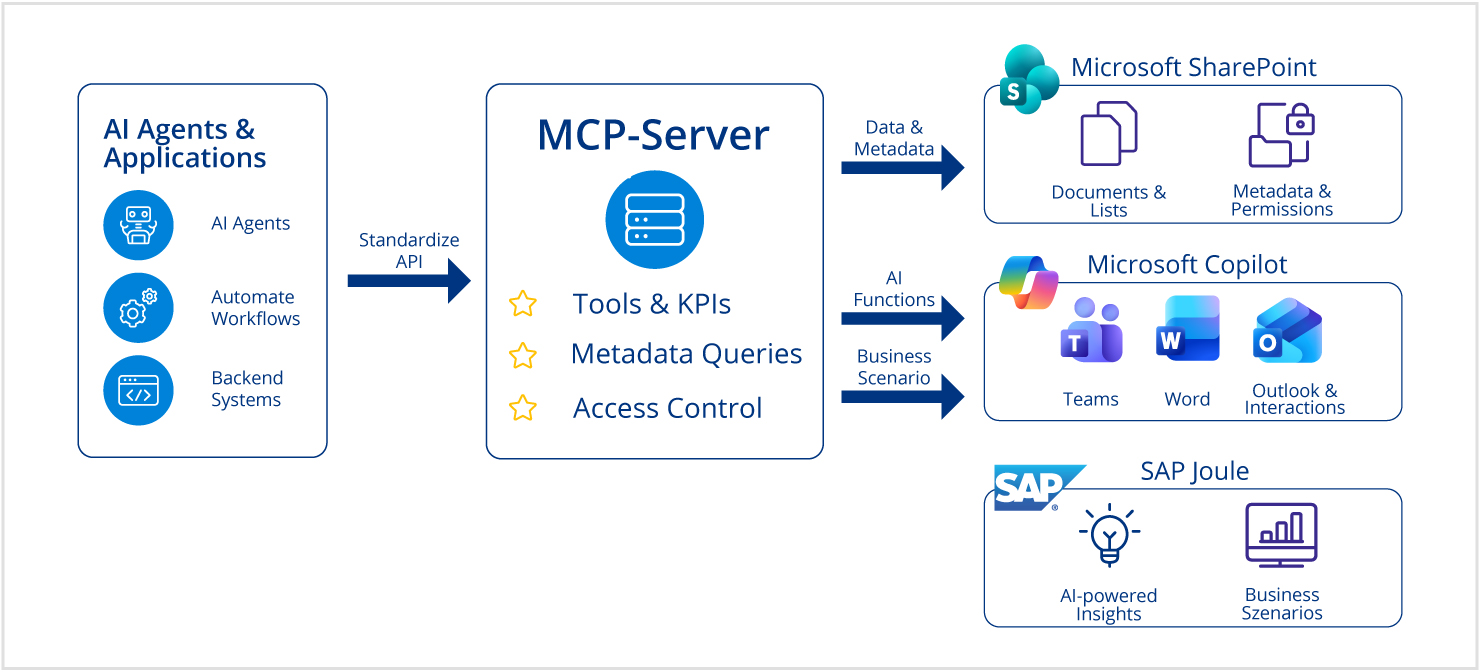
As the graphic illustrates, the Model Context Protocol acts as an intelligent standard adapter between your AI applications and data sources. Instead of building a separate, rigid interface for each system, AI agents access the MCP server via a central, standardized API. The MCP server works as a security instance in three layers:
- Tools & APIs: Provide the AI functions to actively execute tasks (e.g. document retrievals).
- Metadata Queries: Provides in-depth context from source systems such as SharePoint or SAP.
- Access Control: Guarantees as a gatekeeper that existing authorizations are strictly adhered to.
The decisive advantage: Whether Microsoft Copilot in Teams or automated workflows in the backend - everyone accesses documents and metadata securely and in real time without having to replicate data.
What is the Copilot MCP Server?
The Copilot MCP Server marks a paradigm shift: it is not a classic integration in which systems communicate rigidly with each other, but an intelligent orchestration. An AI agent acts as a host and controls several MCP servers (SAP, SharePoint, archive) in parallel. This reduces the integration effort and ensures compliance.
- Model-independent: Change the AI model without changing the connection.
- Standardized: Use a standardized protocol for all data sources.
- AI-enabled: Data is provided in such a way that agents "understand" it immediately.
The protocol uses three central components for this purpose:
- Tools: Active functions (e.g. retrieve SAP documents, SharePoint search, read archive metadata).
- Resources: Secure access to data pools under strict authorizations (SAP tables, SharePoint libraries, archives).
- Prompts: Predefined interactions that accurately control AI agents in complex business processes.
The Synergy: Three Worlds Merge Into One Process Knowledge
1. SAP: Joule becomes context-enabled
On SAP Business Technology Platform (BTP), Joule acts as MCPClient and references MCPServer, as with CAPServices or the AI Core context data and functions.
Document data & transaction history: Direct access to complete document structures and the transaction history.
Business Objects: Access to SAP Business Objects, including its complete structure, life cycle, and status logic.
IDs and semantic relationships: Use of master data and document IDs and their semantic relationships.
- Customizing metadata: Consideration of customer-specific fields (Z-fields), which often remain invisible to standard AI.
- Authorization context: Adoption of SAP user roles (PFCG) so that the AI only sees what the user is allowed to see.
Your benefit: SAP becomes AI-capable, auditable, and remains independent of the selected LLM (model agnostic).
2 SharePoint: Knowledge spaces become process knowledge
SharePoint contributes unstructured documents that enrich the structured SAP process:
- Technical documentation: Specifications, CAD drawings, and assembly instructions.
- Legal context: Contracts, SLAs, and supplementary agreements.
- Project history: Emails, logs, and project documents from M365 groups.
AI agents access securely via the SharePoint MCP server:
- Documents & Versioning: Access to the currently valid version of a document.
- Taxonomies & Managed Metadata: Use your central keyword hierarchies for better categorization.
- Purview labels & Sensitivity: Strict adherence to confidentiality levels (e.g., "Strictly confidential").
- Hybrid search: A combination of classic search and vector search for more precise results.
Your benefit: Process knowledge without data replication, fully compliant and secure within your tenant.
3. digital archive: audit compliance meets AI
Digital archives remain the immutable system of record. MCP enables the decisive breakthrough for access to archived data:
- In-situ analysis: Read-only access directly at the storage location - no moving of archive material to AI clouds.
- Integrity protection: Absolutely no replication or modification of the original bit streams (WORM principle is maintained).
- Full audit trail transparency: Logging of every AI query in the archive journal (who read which information for which prompt and when?).
- Cross-system mapping: Automated linking of archive documents with current SAP IDs and SharePoint knowledge via MCP resources.
- Retention awareness: The AI automatically respects deletion deadlines and retention rules of the archive.
Your advantage: Archives are transformed from a "data tomb" into an active treasure trove of knowledge without jeopardizing their legal status (GoBD/Compliance).
Practical Example: Complaint Check In Seconds
A customer complains: "Wrong specification delivered!" MCP orchestrates the response across all systems:
- SAP-MCP provides order data and object IDs.
- SharePoint-MCP finds the specification valid on the order date.
- Archive MCP integrates the delivery bill and test report in an audit-proof manner.
The result: A complete, verifiable complaint analysis in seconds - cross-system and compliant.
Why the Model Context Protocol Determines the Success of Your AI Strategy
- Massive increase in efficiency: The standardization of the interface logic eliminates the need to set up complex, individual data pipelines for each new source.
- Data sovereignty: No moving or copying of data. Information remains audit-proof and controlled in the source archive.
- Audit security: Every access of the AI via the protocol is carried out according to fixed rules and is fully traceable for compliance.
- Future-proof: A model-independent standard that works with systems like Claude today and will be seamlessly ready for any form of agentic AI tomorrow.
In a Nutshell: Your Advantages at a Glance
- No replication: Your digital archives are intelligently indexed, not copied. This conserves resources and protects data integrity.
- Automated compliance: By linking access authorizations and seamless auditing, every AI step takes place directly on the system of record.
- Breaking down data silos: AI agents work across systems for the first time and merge process knowledge from SAP, SharePoint and the archive in real time.
Conclusion: The Basis for Real AI Value Creation
The Model Context Protocol ends the era of outdated integration logic. The result is an architecture in which archives are not replicated but intelligently accessed. MCP combines SAP, SharePoint and digital archives into an AI-enabled, auditable information world for the first time. This is the foundation for Agentic AI or rather AI-supported processes that not only chat, but also understand and support complex business processes.
Are your systems ready? Contact us for an MCP checkup.
Revision security & AI: FAQ on the Model Context Protocol
-
What is the difference between MCP and classic REST APIs?
While REST APIs were developed for rigid communication between two fixed applications, MCP is optimized for dynamic interaction between AI models and data sources. MCP standardizes not only the data transport, but also the description of capabilities (tools) and data structures (resources). This means that an AI immediately understands how it can use the interface without manual programming.
-
Is the Model Context Protocol an open standard?
Yes, MCP is an open standard that defines how AI models communicate with external systems, tools, data sources and workflows via a standardized interface. For companies, this means investment security: any available MCP server can be used by various AI clients (e.g. Claude, Microsoft Copilot or your own LLM apps) and integrated into AI processes.
-
Does MCP replace existing interfaces?
No. MCP acts as a standardized "wrapper" for existing APIs. It standardizes the way an AI addresses these interfaces, which massively shortens the implementation time for new AI use cases.
-
How does MCP solve the problem of "hallucinations" in AI agents?
Hallucinations are often caused by a lack of context. MCP gives AI real-time access to verified data sources (system of record) such as SAP or digital archives. By providing "resources", the AI works with exact facts instead of just based on its training knowledge, which drastically increases answer quality and fact accuracy.
-
What happens with data protection (GDPR)?
MCP is a "context-on-demand" protocol. No data is replicated in advance to external clouds. The data flow only takes place at the moment of the specific request. Existing authorization structures (e.g. in SharePoint or SAP) are strictly observed and controlled by the MCP server as gatekeeper.
-
Can MCP be used to comply with the GoBD?
Absolute. As MCP only enables read-only access, the archived original documents remain untouched. The immutability that is critical for GoBD compliance is fully maintained, while the AI only extracts the metadata and content for analysis. The archive remains the untouched system of record.
-
Does MCP also work with on-premise archives?
Yes. An MCP server can be hosted locally in your infrastructure. It thus acts as a secure gateway between your local archive and a verified AI instance. Sensitive data only leaves the company in encrypted form and in context.
-
Do I need a separate MCP server for each archive?
In general, every ECM manufacturer provides its own MCP server. MCP is designed to orchestrate multiple data sources. An AI agent can simultaneously maintain connections to an SAP MCP server, a SharePoint MCP server and an archive MCP server in order to merge information across systems. If several archive solutions are in use and have an MCP server, they can be seamlessly integrated.


Written by
Heiko Rettig-Wenke has over 25 years of experience as an ECM and cloud consultant in the field of digital archiving. As a solution architect, he advises customers on the use of various archiving and SAAS solutions and is familiar with the two worlds of SAP and Microsoft 365.