


Thinking About AI Use Cases Correctly
From the feature trap to the agent workflow


Companies today face a crucial question: how can AI use cases be designed to not only automate individual tasks but also generate real, measurable added value? The answer lies in intelligently linked AI workflows that support processes end-to-end, rather than just providing isolated functions. Those who integrate AI into processes in a targeted manner will gain a competitive advantage that goes far beyond the use of AI chatbots. We show why many organizations are still stuck in the feature trap - and how agent-based workflows are taking the decisive step forward.
“AI Goes Workflow”: Why Chatbots Are Not the Final Solution

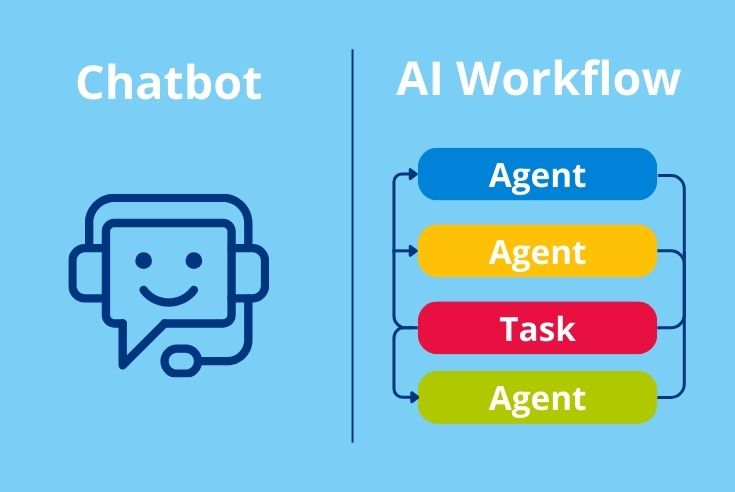
Artificial intelligence promises enormous efficiency gains in business processes. In practice, however, "powered by AI" often means nothing more than a chatbot that answers routine questions. Even platforms that provide several specialized bots typically follow the "one-tool-per-job" principle, where each solution handles its own part. There is hardly any networking of output or intelligent mutual optimization. As a result, humans continue to do the majority of the work, even though AI could do more, and many AI use cases remain unused.
Additionally, when utilizing custom agents from Microsoft and OpenAI, a pattern emerges: initial enthusiasm, followed by disillusionment. Although Microsoft Copilot and ChatGPT are powerful functions, their usefulness depends heavily on the user. Depending on the level of AI expertise, working with custom agents ranges from highly efficient to barely adequate. Managers, therefore, often fail to see any noticeable process improvements or measurable cost benefits.
The central mistake: companies focus too much on features instead of processes - and thus miss out on the potential of effective AI use cases.
The Right Perspective: Processes Instead of Features
AI is fundamentally changing the way we understand processes: Copilot, ChatGPT, and other AI tools are taking over operational routines, while users recognize connections, make decisions, and contribute their expertise. Employees are focusing more on optimizing the system rather than operating it.
To achieve real added value with AI, companies must think consistently in terms of AI workflows. To do this, departments and specialist areas should clarify the following questions when using AI:
- Define goals: What effect should be achieved – for example, reducing costs, reducing errors, or shortening throughput times?
- Understand processes: What activities, roles, interfaces, and systems are part of the process? Where are the pain points or recurring tasks?
- Clarify agent potential: What challenges can be solved by AI agents? What steps can be linked to enable AI workflows?
- Rethink processes: Does the existing process make sense (brownfield)? Or is a radical redesign (greenfield) approach, involving a network of specialized agents, worthwhile?
- Develop solution design: What building blocks—such as LLMs, data sources, or integrations—does my AI workflow need? How do the agents interact with each other?
- Define human-in-the-loop: How do roles, responsibilities, and capacities change when AI agents take over the work?
Answering these questions creates a solid foundation for effective AI deployment.
Targeted and Structured - What Makes a Good AI Workflow
An AI workflow in which one or more agents take on defined tasks is part of an end-to-end process - from the database to task control to the decision or execution.
For an AI workflow to be truly effective, it must fulfill four criteria:
- Targeted: The workflow pursues a clear, measurable effect - such as saving time, increasing quality or reducing costs.
- Structured: Tasks, roles, inputs and outputs are clearly defined
- Automated: The steps can be taken over by agents based on rules or data - completely or in interaction with humans.
- Measurable: The quality and effect of the use of AI can be tracked via KPIs or process indicators.
Once these requirements have been met, the question arises: How can such AI workflows be implemented in practice? An effective starting point is the brownfield approach.
Brownfield: Integrating AI Into Existing Processes

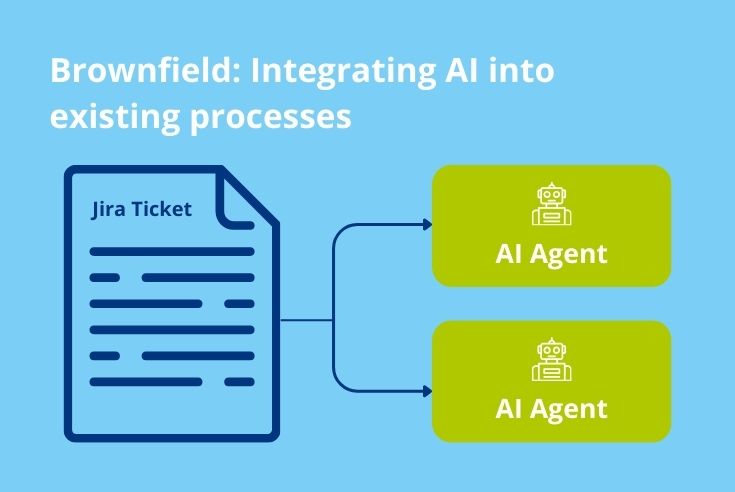
In the short term, there is no alternative to the brownfield approach: existing processes are translated into technical workflows and made more efficient through the use of AI. One example is the use of Jira: every business transaction is mapped as a ticket, allowing standardized processes to be versioned, scaled, and measured. AI agents can be used on an event-triggered basis: They take on defined tasks, support people in a targeted manner, or work independently. This creates a scalable, traceable AI effect.
The tender process is an example of this: an agent searches the market for tenders and creates them as tickets. Further steps, from the portfolio check to the offer, are carried out jointly by humans and AI along the workflow. This creates a precise, repeatable, and resilient AI use case.
Greenfield: Visionary Agent Networks
While the brownfield approach remains close to existing processes, the greenfield approach goes much further: agent networks implement goals directly - input in, output out, without any classic process loops.
An IT service provider could transmit customer requests to a routing agent by voice command. This agent coordinates specialized agents who create offers, negotiate, manage implementations, and even provide infrastructure. This makes companies more flexible and allows them to react more quickly to individual requirements.
However, this future has clear limits: Powerful agent networks of this kind do not yet exist. Whether and when LLMs will reach this level is unclear. Still, the greenfield approach already indicates where the journey is heading: towards more flexible and dynamic workflows in which AI agents not only provide support, but also design entire processes independently.
The greenfield approach is visionary, but it is not yet a reality. Those who want to create real added value today rely on the brownfield approach: with solutions that work, while also leaving room for further development.
Tools do not create the impact, but rather well-thought-out AI workflows that integrate AI specifically into processes and realize concrete AI use cases throughout the entire value chain.
Written by