


Agentic AI in Practice
Smart automation quickly with n8n

Just a few years ago, process automation was the privilege of large companies with big budgets and specialized IT teams. Those who wanted to digitize workflows had to navigate complex systems, rigid interfaces, and expensive licensing models - not to mention the actual intelligence required in the process.
However, companies are under massive pressure today: rising costs, volatile markets, and demographic changes make it more urgent than ever to examine their own processes and actively leverage their efficiency potential.
In recent months, the playing field has undergone a radical shift: generative AI demonstrates that digital intelligence is now accessible to everyone. This is precisely where n8n comes in - an automation tool that bridges the gap between technical complexity and practical feasibility. With its open, flexible architecture, it enables processes to be linked intelligently, AI models to be integrated, and workflows to be automated - without the need for a development team or a huge budget. n8n brings tangible reality to what was often just a buzzword until now: agentic AI in action - simple, comprehensible, and immediately productive. In this article, we present the basics of n8n, show initial use cases, and offer support for the first steps.
What Is n8n?


n8n is a powerful platform for workflow automation. The name stands for "nodemation" and already refers to the basic principle: nodes are connected in such a way that automation is created.
Automation with nodes can be wonderfully compared to terminal blocks: different, pre-formed elements can be combined as desired, with no limits to creativity.

However, in n8n, these "building blocks" are not colorful little stones, but technical components. For example, one node can send an email while another retrieves data from the ERP system. Some nodes even establish connections to large language models (LLMs), i.e., technologies such as ChatGPT and Copilot. This means that automations are no longer rigidly bound to fixed processes. They can act intelligently, make decisions, and react dynamically - in short, they become AI agents.
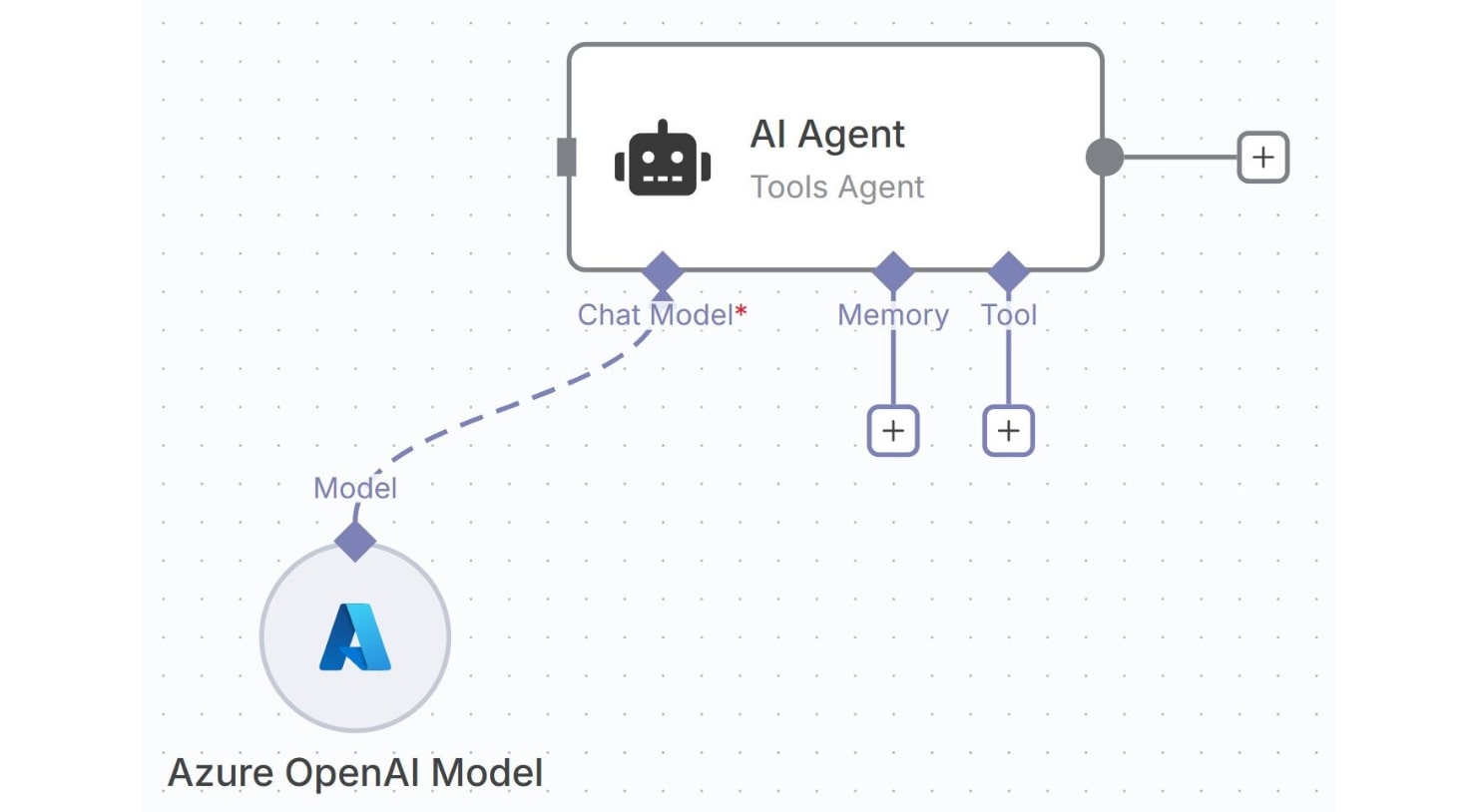
Figure 2 clearly illustrates how n8n can be used flexibly to build intelligent automation. Here, the Azure AI model is integrated and parameterized via a node, which means that the AI logic is integrated directly into the workflow and interacts with other process steps. The AI agent node shown in the example is particularly exciting: It not only enables connection to a model, but also configures two central components - memory and tool.
The memory component serves as a memory or knowledge base that the agent can access during the execution process. The tool, on the other hand, defines which software or system component the agent should actively interact with - such as a database, a CRM system, or a communication channel. This combination creates a highly flexible, AI-controlled process logic. The plus-symbol on the right-hand side of the node can also be used to add further connections or inputs to seamlessly link the agent with additional data sources or actions - the first step towards a knowledgeable automation network.
How to Get Started with AI-Based Automation with n8n
This principle has several advantages. For specialist departments, getting started is extremely easy and low-threshold. At the same time, the technical capabilities of the nodes offer enormous depth, ideal for development experts who want to design sustainable and efficient automation. Another plus point: openness. Companies can operate n8n both locally and in the cloud - a decisive advantage for anyone who wants to retain their data sovereignty.
The Berlin-based company behind n8n sees itself as a platform that enables organizations to map their processes as they actually are: comprehensible, modular, and expandable at any time.
This positions n8n as an interface between artificial intelligence and business process management(BPM) and is becoming an exciting tool for BPM and AI teams alike.
Application Example: Automating Termination Requests with Agentic AI and n8n

Companies today face the challenge of processing vast volumes of emails and documents daily. Especially in input management, the effort involved is enormous: customers send notices of termination, inquiries, or address changes, for example. This often means manual review, assignment, data checking, and formulating responses.
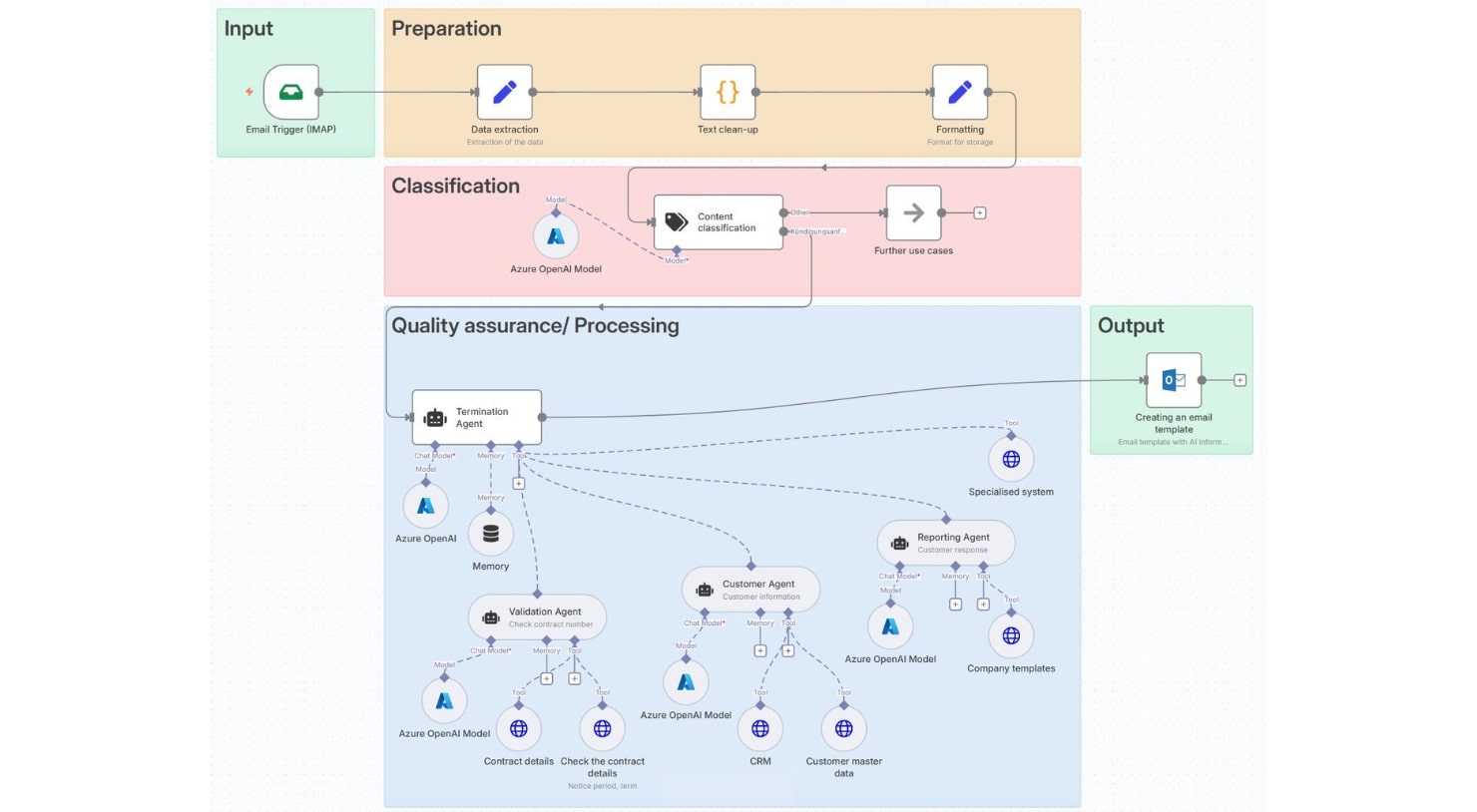
With AI agents and tools such as n8n, this process can be almost entirely automated. In the following example, we examine a cancellation request at an insurance company. In this process, a company receives a termination request by email. Historically, this email had to be assigned to the correct administrator, who then checked the contract data, asked questions, and sent a confirmation. With the help of n8n, this can be automated. To achieve this, we will explain the five automated phases in Figure 3 sequentially and describe the functions of each node.
The Process at a Glance
-
Input: Receipt of the e-mail
An email with a termination request lands in the inbox (e.g. via IMAP). The workflow starts automatically.
-
Preparation of the data
In order for the AI to be able to work with the information, the content is first standardized:
Data extraction: Relevant text content is filtered from the email.
Text cleanup: Signatures, special characters and non-task-relevant information (e.g. sensitive information that is not required for processing) are removed.
Formatting: The text is converted into a uniform format.
-
Classification of the request
An AI model recognizes what type of request it is. In our example: termination. Other options would be e.g. change of address, contract amendment or damage report.
-
Quality control and processing
This is where the actual intelligence of the system comes into play. Several specialized agents work together:
Cancellation agent: Controls the overall process for cancellations.
Validation agent: Checks whether the specified contract number exists and whether the contract can be terminated (e.g. compliance with the notice period)..
Customer agent: Retrieves further information from CRM or master data (e.g. contact data, contract status)..
Reporting agent: Creates the appropriate customer response based on company templates.
All agents access Azure OpenAI models, databases and company systems (CRM, specialist systems).
-
Output: Automatic customer response
At the end, the system creates a personalized email template with all relevant information. The email can be sent directly or first checked by an employee.
With this approach, requests are processed in the shortest possible time. Employees have more time for value-adding activities. At the same time, the error rate decreases because manual input is eliminated and customer satisfaction increases thanks to fast, clear and consistent responses.
This example shows how agent systems can bring real efficiency gains in input management. What used to be a combination of manual reading, copying, checking and writing is now performed by specialized AI agents that cooperate with each other. The best thing about this is that workflow automation tools such as n8n allow such processes to be set up on a modular basis and expanded flexibly. Be it for notices of termination, address changes, damage reports or many other scenarios.
n8n vs. Classic Automation Tools: Advantages for Agentic AI

n8n is not just another tool in the automation landscape, but a fully-fledged workflow engine that differs significantly from classic solutions thanks to several technical features:
Agentic AI and Automation: Why Act Now?
Cost printing as a driver
The processing of everyday routine tasks consumes resources that are otherwise lacking elsewhere. While traditional automation solutions are often associated with high license costs or rigid structures, n8n offers the opportunity to start cost-efficiently and flexibly.
Using AI sustainably
Large language models and agents are on the rise. But without a platform that seamlessly integrates them into existing processes, their use remains sporadic and inefficient. n8n offers precisely this integration framework. It bridges the gap between humans, systems, and agents, enabling responsible, scalable use of AI.
Future-proof process architecture
Those who rely on n8n today are not only creating short-term efficiency gains. The platform forms the foundation for a new generation of workflows that are small-step, transparent, and expandable. Every future innovation, whether it involves a complete automation layer or an agent workflow level, is built on this foundation.
The decision to use n8n is therefore not a matter of experimentation, but an investment in the future viability of the company.
Why Arvato Systems Is the Right Partner
Technology alone does not create added value. The decisive factor is the ability to embed it in the right processes, operate it securely and design it in such a way that it supports the people in the company instead of blocking them. This is precisely where Arvato Systems' strength lies.
Industry and technology expertise
We understand the challenges that affect companies across a wide range of industries, from healthcare and energy to media and financial services. Our team brings deep expertise in automation, AI, and cloud infrastructures. This combination ensures that solutions don't stay in the lab, but work in practice.
Experience with automation at all levels
From Robotic Process Automation (RPA), intelligent document processing, and the use of AI agents, We have already implemented numerous projects in which automation generates real business value. n8n is not an end in itself for us, but a tool that we use specifically when it creates the most significant benefit.
Scalability and security
Scalability, governance, and compliance are essential, especially in the enterprise environment. Arvato Systems ensures that n8n not only works as a fast prototype but can also be operated robustly in large organizations and seamlessly integrated into existing IT landscapes.
Innovation with structure
We don't see automation as a one-off solution, but as a building block for continuous innovation. With n8n, we work with our customers to lay the foundations for process landscapes that are open to future technologies, all the way through to agent-based workflows that act independently and make informed decisions. This turns an automation tool into a strategic asset.


Written by
Jonas Spiekermann is a business analyst for intelligent automation at Arvato Systems. With a focus on RPA and GenAI, he is driving forward digital transformation. His goal: to make processes smarter and more efficient. Together with his team, he develops intelligent solutions that bring about lasting change to everyday working life in companies.