


Digital product passport
Transparency and sustainability along the entire value chain

The digital product passport - the basis for environmentally friendly and recyclable products
The EU Ecodesign Regulation will gradually make the Digital Product Passport mandatory from 2027. In principle, this application applies to almost all physical goods that are manufactured or imported within the EU. This also includes intermediate products such as individual components and raw materials. Even if your company is not yet directly affected, it is worth setting the course for the future today.
Because a well-implemented digital product passport offers more than just compliance: it is the key to greater transparency and efficiency along the entire product life cycle. It also increases productivity, promotes innovation and opens up new business models. Companies that see the Digital Product Passport, or DPP for short, as an opportunity rather than an obligation will secure long-term competitive advantages in a data-driven and sustainable economy.
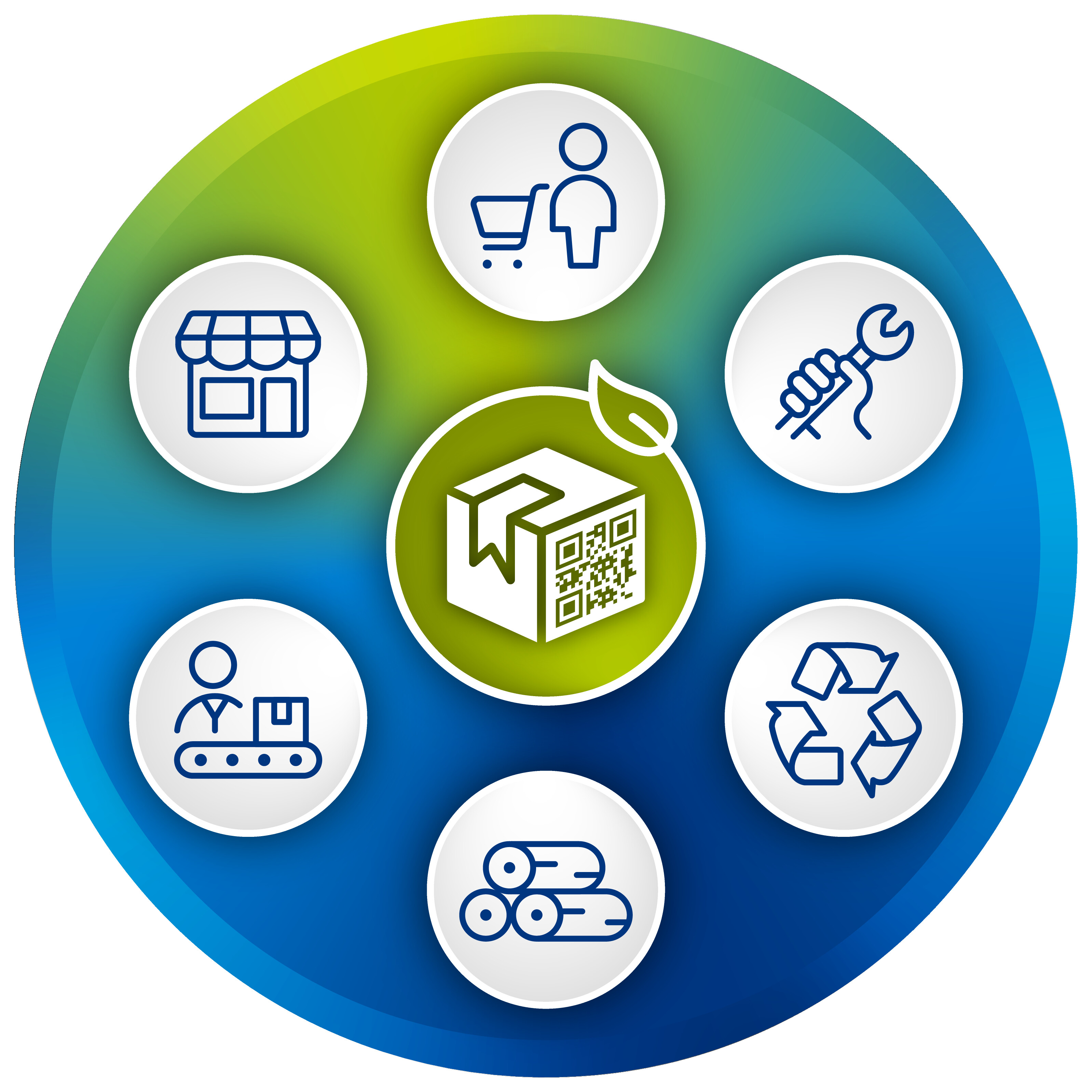
The digital product passport is coming - breathe a sigh of relief! Together we turn complexity into actionability.
A digital passport accompanies the entire product life cycle - from the raw material through production, shipping and distribution to the end customer and back to the manufacturer for sustainable upcycling.
What is the Digital Product Passport and what opportunities does it open up?
The digital product passport is a digitally retrievable data set for a specific product that provides key information such as material composition, chemicals contained, repair and recycling options. This standardized data can be accessed seamlessly via a data carrier that is permanently linked to the product (e.g. a QR code) and viewed by all stakeholders along the entire supply chain.
With the Digital Product Passport, companies can not only comply with current EU regulations, but also benefit from a wide range of opportunities.
When will the Digital Product Passport become mandatory?
The Digital Product Passport will be introduced gradually and is the central instrument for greater transparency, sustainability and future viability of products in Europe. The exact start date depends on when the respective EU requirements for individual product groups are adopted. As a rule, the publication of a delegated act is followed by a transitional phase of around 18 months, which gives companies sufficient time for implementation.
No additional delegated act is required for certain product groups, as the introduction of the Digital Product Passport is regulated directly in separate EU regulations. A prominent example is the EU Battery Regulation, according to which the Battery Passport will be introduced on a mandatory basis and will apply from February 2027.
In addition, other product areas are developing along their own regulatory frameworks, which are closely linked to the new Ecodesign for Sustainable Products Regulation (ESPR) or will be linked to the Digital Product Passport in the future. These include the Construction Products Regulation, the Toys Regulation and sector-specific regulations in the area of chemicals and detergents.
The dates shown are based on the EU Work Plan 2025-2030 and form the current orientation framework for the introduction. They serve as a strategic guard rail and may evolve over the course of the political process. The underlying roadmap and timetable were drawn up in January 2026.

What data will be part of the Digital Product Passport?
The information that the digital product passport must contain is determined individually by the EU for each product group. The specific requirements are set out in delegated acts. Nevertheless, each draft follows the same basic principle: the Digital Product Passport bundles relevant product information along the entire life cycle and makes it digital, structured and accessible.
Depending on the product group, a digital product passport can typically contain the following data and information blocks, among others:
- Product identification
Unique product identification (e.g. model, batch or serial number) including digital reference to the product passport. - Product and material information
Information on materials, components and material compositions used and - where relevant - on regulated or critical substances. - Proof of origin and supply chain information
Information on manufacturing and processing locations as well as the origin of selected materials or raw materials, especially where transparency, sustainability or regulatory requirements require this. - Sustainability and environmental information
Data on environmental impacts such as CO₂ footprint, use of resources, recyclability or recycled content - depending on the product group. - Performance and quality characteristics
Product-related parameters such as durability, reparability, energy or water consumption and comparable key performance indicators. - Use, maintenance and repair information
Digital instructions for the safe use, maintenance, repair, disassembly or reconditioning of the product. - Information on end-of-life
Information on reuse, recycling, disposal and take-back options to support a functioning circular economy. - Conformity and regulatory information
References to relevant EU regulations, standards, certifications or declarations of conformity.
In addition, the content of the Digital Product Passport is provided at different levels of granularity - for example at model, batch or individual product level, depending on the product type and regulatory requirements.
In addition, the information is accessible based on roles and rights: while certain basic information may be publicly available, more extensive or sensitive data is only available to authorized stakeholders such as manufacturers, repair companies, market surveillance authorities or recycling companies.
What could a digital product passport look like?


We have created an example mockup that shows what a digital product passport for users can look like in a web app. The mockup was developed by young talents from Arvato Systems as part of a project and illustrates how information on materials, carbon footprint, maintenance and recycling can be clearly presented.
Tip: Scan the QR code to get the clickable version - for an even better impression.
Digital product passport: how to implement it in a structured way
The introduction of the Digital Product Passport entails complex requirements - from data management to system integration. Structured implementation is therefore crucial. The following steps show a practical approach.
- Strategic evaluation & target definition
- Data & system analysis
- Identifier & Structure traceability
- Define data model & templates
- Build system architecture & interfaces
- Realize data transmission & display
- Introduce rights management and role model
- Training, piloting and go-live
- Monitoring, analysis and maintenance
Prepare your product information at an early stage and use the advantages of the DPP now to achieve your goals. This way, you will be optimally prepared as soon as the DPP obligation comes into force.

Our conclusion
The Digital Product Passport requires the structuring of the data landscape and offers numerous opportunities beyond the mere obligation. The introduction of the Digital Product Passport helps companies to structure their data landscape and create transparency in the supply chain. A proactive approach to the DPP not only means compliance, but also increases efficiency and productivity and opens up new business models - across different industries. Those who use the DPP as an opportunity will secure sustainable competitive advantages.
The Digital Product Passport (DPP) comes with new challenges: product information must be structured, consistent and made available throughout the entire life cycle. These requirements are best met with an experienced partner who combines regulatory understanding, data expertise and integration capability.
Our experience in highly regulated environments - particularly in serialization and regulatory compliance - forms a solid basis for this. For years, we have been supporting pharmaceutical companies in implementing complex legal requirements, including EU Directive 2011/62/EU (Falsified Medicines Directive). In addition, 17 European countries have transferred the operation of their national verification systems to our responsibility. These projects show that we are able to translate demanding regulatory requirements into scalable, reliable IT solutions.
This know-how can be transferred to the requirements of the Digital Product Passport and is supported by our expertise in Product Information Management (PIM) and in the Customer Experience (CX). In consumer goods environment as well as for our industrial customers we have been working for years on the structuring, harmonization and use of product data - both for internal processes and for external information and usage contexts. This creates the conditions for digital product passports that combine regulatory transparency with operational efficiency and user-oriented information provision.
Sovereign IT means security, data protection and independence. It is the basis for the targeted use of modern technologies such as the cloud and AI, even in sensitive areas. The right balance between innovation, security and self-determination is crucial. We make your IT sovereign.
From data modeling and system integration to scalable cloud architectures and IT security, we are able to map the digital product passport holistically. As an integrator and trailblazer, we network systems and data across departmental and company boundaries, provide practical advice, establish best practices and support our clients in translating regulatory requirements into sustainable, future-proof solutions.
- We are an innovation partner of GS1 and are active in working groups relating to the Digital Product Passport.
- As part of our Factory-X consortium partnership, we actively support the further development of the architecture, in particular the Manufacturing-X-Port concepts.
- Jointly with the Institute for Industrial Information Technology - inIT, the Ostwestfalen-Lippe University of Applied Sciences and other partners, we have been involved in a research project on DPP for several years.
Frequently asked questions and answers about the Digital Product Passport
-
What is the Digital Product Passport and why is it relevant for organizations along the value chain?
The digital product passport is a structured digital data set that makes central product information - for example on materials, components, origin and recycling - available throughout the entire life cycle. Access is via a data carrier, for example a QR code, which - where possible - is attached directly to the product or alternatively on the packaging or in accompanying documents. This means that relevant information can be accessed digitally at any time - for greater transparency, easier repairs, more efficient recycling and well-founded decisions along the value chain.
-
What legal requirements must companies observe with the Digital Product Passport?
From 2027, the Digital Product Passport (DPP) will gradually become mandatory in the EU - initially for industrial batteries and later for other product groups such as textiles and electronics. Companies that manufacture in the EU or supply products to the EU market should prepare early to avoid regulatory risks such as fines, sales restrictions and reputational damage.
-
How does the Digital Product Passport promote sustainability and ESG goals in the manufacturing industry?
The Digital Product Passport makes environmental indicators such as CO₂ footprint and recyclability visible. Manufacturers can thus transparently track and document their sustainability and ESG goals, which both fulfills regulatory requirements and creates trust among customers and investors.
-
How does the digital product passport improve transparency along the value chain?
The Digital Product Passport increases transparency along the value chain by making relevant product information - for example on origin, materials and manufacturing processes - available centrally and digitally. This enables organizations to better document sustainability and quality requirements and strengthen the trust of business partners, supervisory bodies and end users.
-
What challenges are there when introducing the Digital Product Passport in companies?
The introduction of the Digital Product Passport is complex: companies have to implement documentation, new processes and IT systems. A lack of standards and data silos cause delays and additional costs. Collaboration with suppliers for complete supply chain data and a well-structured database are essential.
-
How can companies efficiently manage their product data for the Digital Product Passport?
Efficient management of product data is the basis for a successful digital product passport. Relevant information should be digitally recorded centrally and consistently merged from existing systems - such as ERP, PIM or production systems. The use of established standards ensures a uniform structure, comparability and reusability of the data. This keeps the digital product passport up-to-date and complete and enables smooth, largely automated data exchange along the value chain.
-
What are the technical requirements for the introduction of the Digital Product Passport?
The introduction of the digital product passport requires a modern IT infrastructure, networked systems (e.g. ERP, PLM) and open data standards. Interfaces and IT security measures ensure secure, efficient data exchange.
-
How does the Digital Product Passport influence the competitiveness of manufacturers?
The Digital Product Passport (DPP) makes companies in Germany and Europe more competitive. Early implementation ensures legal conformity, strengthens sustainability and creates trust among customers. Those who offer comprehensive product data gain a clear advantage - latecomers risk sanctions and damage to their image.


Your Contact for the Digital Product Passport